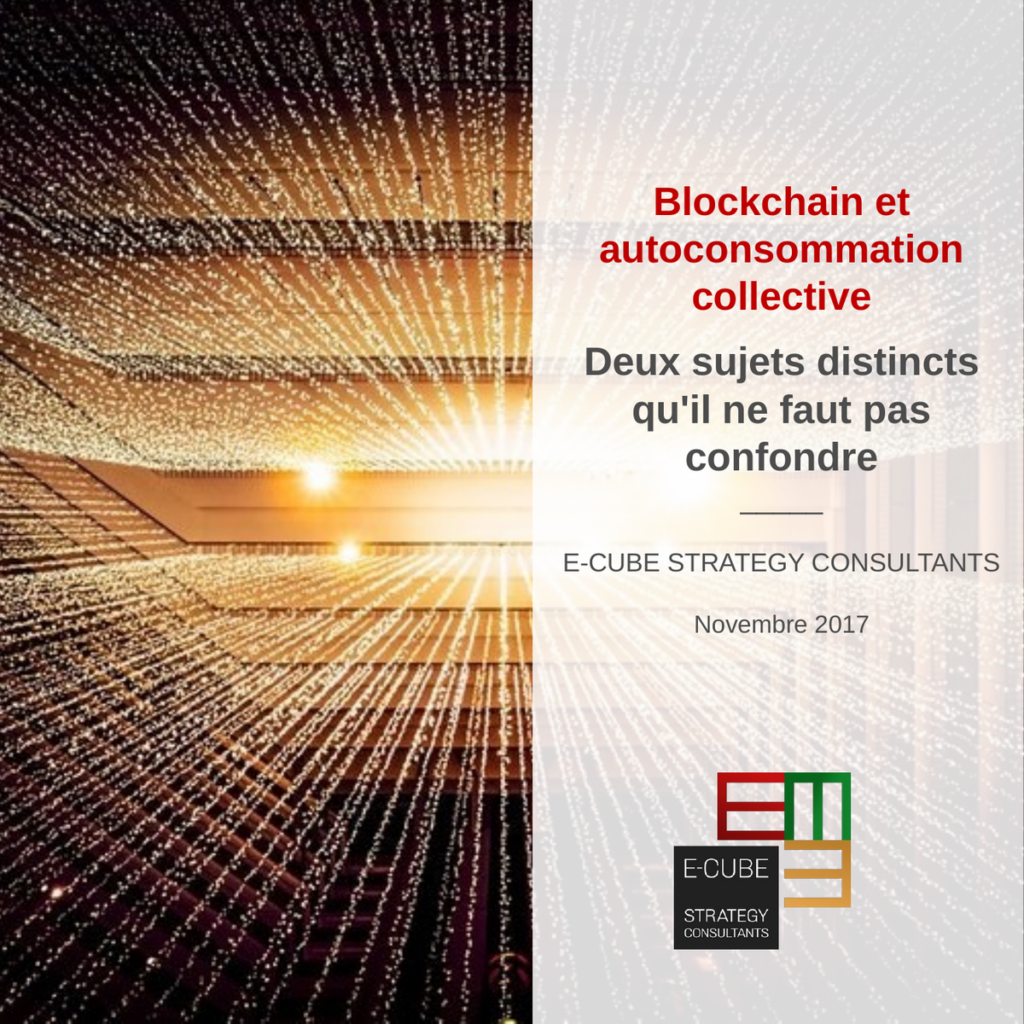
Collective self-consumption and blockchain are two emerging phenomena often wrongly bundled together. Collective self-consumption can exist without blockchain, using conventional IT; and blockchain serves far wider use cases. The useful question is therefore precise: can blockchain improve how collective self-consumption works, or accelerate its growth?
What collective self-consumption actually is
Setting up a collective self-consumption scheme means establishing a contractual framework for electricity transactions between injection and withdrawal sites within a pocket of the distribution network, aiming at instantaneous supply-demand balance at local level. Its development rests on three innovations: distributed generation, low-cost storage, communicating meters.
Under certain conditions it offers real benefits to the system, participants and local authorities: bill savings, deferred network investment, lower line losses, local economic activity.
It does raise substantial issues. It could change players’ roles by pushing them up the value chain. Above all it requires significant regulatory adaptation, and could call into question the uniform postage-stamp principle in network tariffs.
Where blockchain’s real value lies
Other IT systems offer the same functionality. Using a blockchain rather than a conventional database is only justified by identifiable sources of value.
The main one is disintermediating the metering operator, or coordinating writes to the register across several parties, where multiple metering operators are active within the scheme’s perimeter.
That is precisely where the French case is unfavourable: most schemes will involve a single network operator, which is also responsible for metering. Disintermediation value does exist in countries where metering is more distributed, the UK, Germany, Switzerland, or in France should the metering monopoly be relaxed.
Technical sources of value remain: transparency for participants, processing speed, IT costs, and resilience against data falsification or loss.
Still at pilot stage
Investor enthusiasm was real, with some start-ups raising more than €20 million in 2017, such as Power Ledger and Conjoule. Incumbents were investing directly, Tepco in Conjoule for example, or backing initiatives, as Engie did within the Energy Web Foundation. In France several projects were emerging, including EDF’s collective self-consumption offer and Sunchain’s DIGISOL project.
Only trials will establish whether blockchain delivers a genuine advantage over conventional databases.
Four other potentially more promising applications
- Wholesale market transaction management, where writing directly to a shared register could disintermediate market operators, clearing houses and brokers. The Enerchain initiative, launched by several large European utilities, had recorded its first transaction.
- Guarantee of origin management, whose register lends itself well to blockchain use across producers and suppliers.
- Electric vehicle charging, where a common transaction register could simplify charging across points belonging to multiple networks, as Innogy’s Share&Charge attempted.
- Building energy standards compliance, with blockchain able to certify the renewable origin of energy consumed.
The practical priority for suppliers and distributors was therefore to run trials, testing blockchain alongside other solutions. In a sector where a growing share of value rests on data use, those who become familiar with the technology first will be first to spot the best opportunities.
To go further, download our full analysis below or contact our experts.