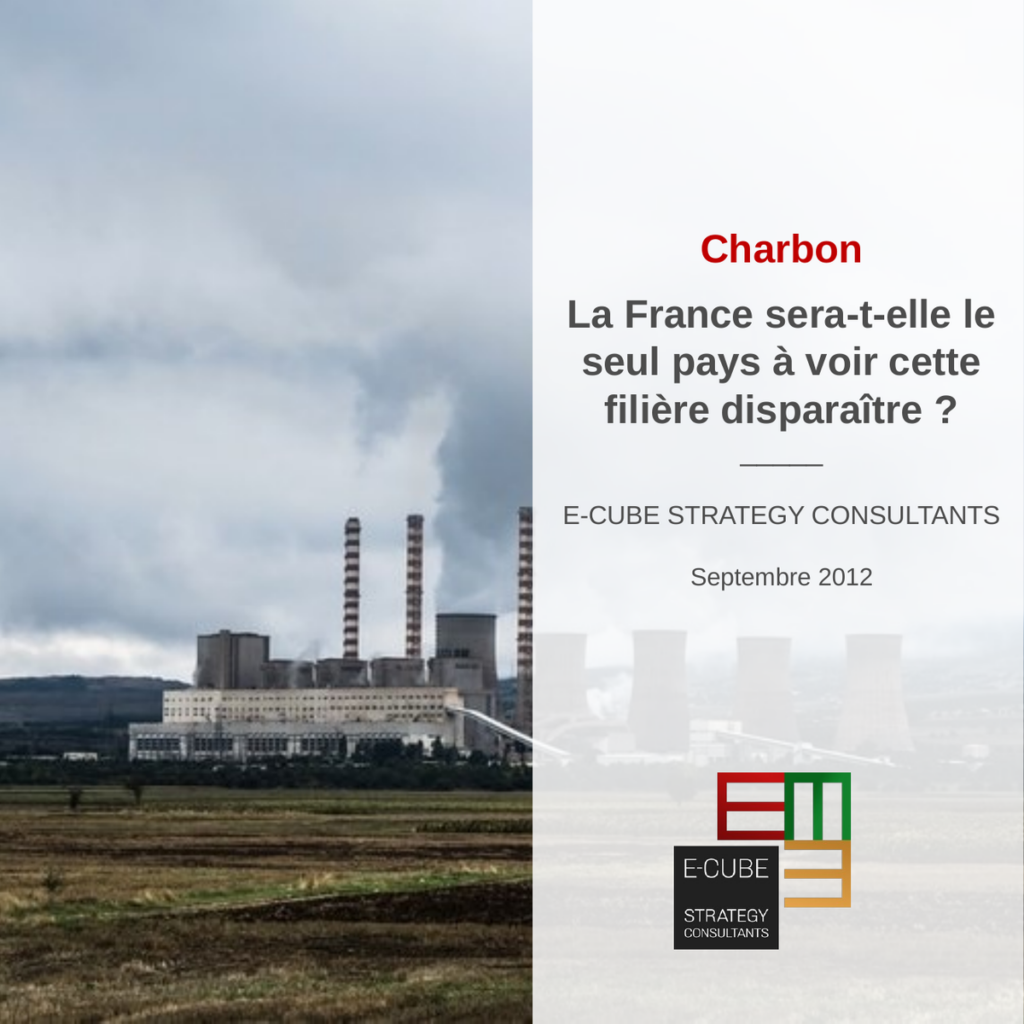
In its supply outlook, the French transmission operator projected the closure by 2016 of all fifteen coal units commissioned before 1975, 3.9 GW out of a 6.9 GW fleet. With no French energy transition scenario mentioning the construction of supercritical plants, the question arose: was France about to become one of the only countries to see its coal sector disappear?
A French exception flowing from nuclear
Coal represented around 6 % of installed capacity but only 3.5 % of output, 19 TWh in 2011. The historic all-nuclear choice confined these plants to mid-merit or even peaking operation: under 2,000 hours for 600 MW units, under 1,000 hours for 250 MW units.
The contrast with Germany is striking. Thanks to natural resources and mining subsidies, coal and lignite there accounted for nearly 30 % of installed capacity and more than 40 % of output, with lignite supplying baseload at 6,600 operating hours a year. A further 17 GW of new capacity was planned by 2022 to accompany the nuclear phase-out. Globally, coal supplied 41 % of power generation in 2009 and was set to remain the leading source in 2035 according to the IEA.
Collapsed profitability
Under the combined effect of falling demand and a 70 % rise in coal prices between 2009 and 2011, the operating margin of 250 MW units turned negative, reaching around -€30/kW in 2011. The better-performing 600 MW units followed the same trajectory while staying positive.
That made any new investment to extend the life of plants built before 1973 unrealistic. And while 2012 brought slight improvement, futures prices to 2015 pointed to continued deterioration, with operating hours falling 30 % between 2012 and 2015.
Four factors that will make it worse
- The large combustion plant directive, requiring environmental compliance upgrades for first-generation plants and therefore heavy investment.
- The end of free CO2 allowances for power plants from 2013.
- The growth of renewables and demand response, reducing operating hours and peak revenues respectively.
- The absence of financial support for clean coal, with carbon capture and storage, ruling out large-scale development of that route domestically.
Inevitable disappearance for the first generation
Our analysis points to missing money of around €45/kW/year for first-generation units, given the heavy investment they would face. Their gradual disappearance is therefore inevitable.
Maintaining a coal sector in France, to preserve know-how and diversify the mix, would require securing the economics of second-generation plants. Three routes emerged: introducing a capacity market immediately with prices above €30/kW/year; an incentive framework for dual-fuel plants, notably biomass and coal, as a transition towards a strong biomass sector; and over the longer term, revised support for carbon capture and storage projects.
To go further, download our full analysis below or contact our experts.
The downloadable PDF of this study is available in French only.