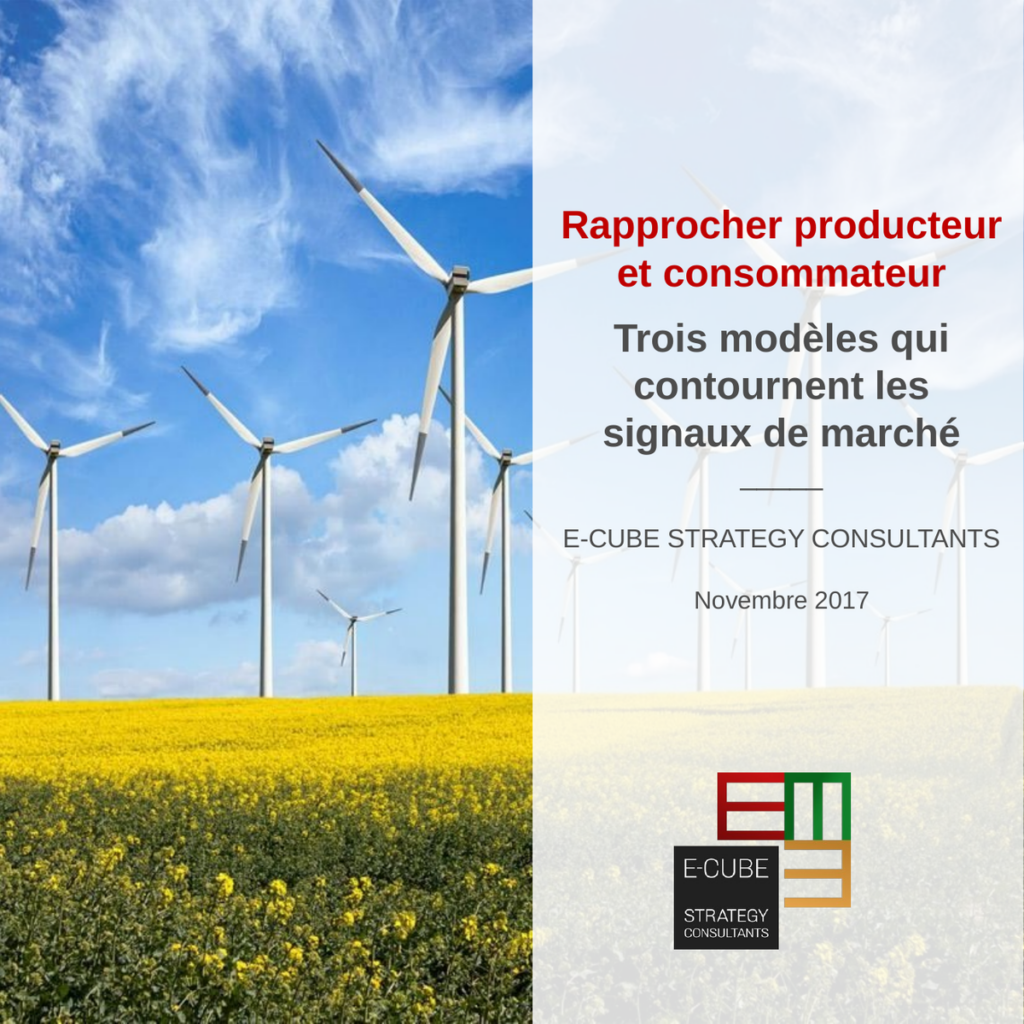
Bringing electricity consumers and producers closer together is a deep trend. Some large consumers arrived there through direct investment in generation, others more recently through corporate PPAs, Google being the emblematic case with 2.6 GW secured long term.
For small customers, residential and commercial, this remained impossible until recently. Several models are now emerging, first centred on the local dimension through rooftop solar, then extending to centralised assets, hydro in particular.
A price signal that does not reflect economic reality
This observation underpins these initiatives. Under the market design of the time, the price gap between gas or coal generation and hydro generation sits between 0.1 and 1 cent per kWh, under 5 % of the final bill, whereas the real costs of renewable generation are significantly higher. A floor-level carbon price and annual European guarantees of origin explain that disconnect.
Three further dynamics push these models: growing consumer appetite for involvement in generation, illustrated by the 2,400 cooperatives recorded across Europe as early as 2014; low prices and shrinking support mechanisms, pushing producers to secure their offtake; and a sharp rise in the value of the customer relationship, with recent retailer acquisitions valuing customers at several hundred francs each.
Three innovative cases
We analysed three cooperative models enabling producer-consumer matching with simultaneous exchanges on a fifteen-minute basis and long commitments, from one to ten years.
e-can.ch, a cooperative launched in October 2017 by Valais producer FMV with enAlpin, Inretis, Misurio and Halter, lets members secure at a fixed price over ten years the output of a Swiss hydro plant of their choice, in a volume matching their consumption for every quarter hour of the year. The customer pays up front for their whole consumption over the chosen period, at a price falling from 7.9 to 7.5 centimes per kWh, around CHF 2,250 for a ten-year commitment by a household of three to four people.
Powerpeers, a Dutch company owned by a large hydro producer, offers consumers a platform for choosing their producers.
Grid+, a North American company, uses blockchain to enable direct exchanges between consumers, producers and prosumers, and more broadly to optimise electricity purchasing.
Physical rather than financial hedging
One feature of e-can.ch deserves emphasis: it is not a financial hedge on consumption but a form of security resting on the technical fundamentals of the plants the consumer selects.
Switzerland’s partially opened market forces adaptations. For an eligible customer, energy is delivered directly. For a captive customer it cannot be billed before market opening: it is therefore sold on the wholesale market and the proceeds returned to the customer, who continues paying their distributor for supply.
Verifying simultaneity on a fifteen-minute basis offers two options: a profiled approach requiring no extra equipment, guaranteeing that output follows the consumption of an average customer; or self-installation by the customer of a communicating meter at limited cost, around CHF 50, allowing their actual load curve to be tracked.
Potentially deep systemic effects
These offers echo Swiss regulatory developments of the period, notably the introduction of consumption groupings, which represent a natural customer base, and the resumption of market opening.
If these models succeed, the impact on the organisation of the power system extends well beyond a niche segment: highlighting the scarcity of renewable energy in Switzerland and Europe, revaluing that energy, converging physical system balancing with commercial offers, the emergence of local markets, and the development of direct governance in energy planning.
To go further, download our full analysis below or contact our experts.