
2026, Towards a Transformation of Business Models?
For the stationary storage market in France, 2025 appears – at first glance – to be a perfect continuation of 2024.
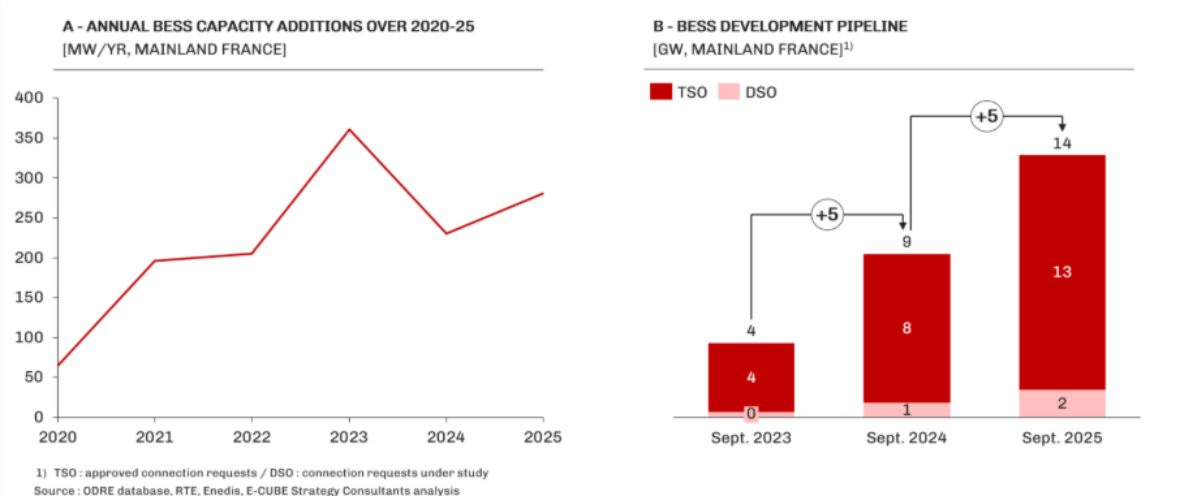
New stationary storage assets commissioned in France stabilized in 2025 at around ~250 MW/year (about 65% on the distribution grid), reaching ~1.4 GW installed by year-end in mainland France – see Graph A. This pace is comparable to the previous year, though slightly below the 2023 peak (350 MW/year).
This stabilization in commissioning is accompanied by steady growth in the project pipeline, reaching ~14 GW in September 2025 (vs. ~9 GW in September 2024 and ~4 GW in September 2023), mostly located on the transmission grid – see Graph B.
These trends might suggest that the sector has found its balance and a sustainable development model – based on standalone batteries primarily monetized through aFRR. However, several signals indicate that 2026 could instead be a year of questioning, or even transformation of current business models, for two main reasons:
- Asset Monetization: A Shift Towards Multi-Market Revenue :
- aFRR prices fell in H2 2025 compared to H2 2024 (from ~€64/MWr/h to €54/MWr/h on average for capacity reservation), a trend expected to accelerate in 2026 with additional battery capacity and new assets joining reserves (e.g., PV > 10 MW).
- This anticipated decline in aFRR prices should redirect BESS monetization toward a greater share of revenues from energy markets, such as intraday (already observed in Germany) or day-ahead markets, whose volatility increased in October with the shift from 30-minute to 15-minute intervals.
- It should also encourage the development of more sophisticated aggregation contracts, enabling tailored value-sharing between aggregator and developer, sometimes even decoupled from physical assets (e.g., virtual or financial FPAs – Flexibility Purchase Agreements).
- Development of New Capacity: Diversified and Agile Models
- Saturation of unconstrained transmission grid connection capacity should drive new models optimizing existing connections (behind-the-meter projects at consumption sites or co-located with renewable generation), potentially speeding up development – a key advantage in shallow markets likely to saturate quickly.
- The growing importance of arbitrage raises questions about the duration of new assets, potentially challenging the current consensus around ~2-hour duration for aFRR monetization.
- Geographic differentiation under TURPE 7 should increase the value of assets developed in constrained zones (injection or withdrawal), benefiting from reduced TURPE tariffs.
This growing sophistication of the sector, both in aggregation and in development, will require the use of new tools and expertise to assess:
- Contribution of “new markets” (day-ahead and intraday) to battery revenues, impact on optimal sizing, and revenue flows retroceded by aggregators to developers (e.g., via backtesting models).
- Relevance of diversifying from pure “standalone” models toward “behind-the-meter” or “co-located with renewables,” and selecting consumption/production segments.
- Impact of project location on profitability and portfolio value (linked to TURPE 7 geographic differentiation).
- Risk-return trade-off of new aggregation contracts and choosing the optimal format for each player, or even each asset.
E-CUBE has developed strong expertise on the topic of battery storage through its recent projects and the experience of its consultants. We would be delighted to discuss these market perspectives and opportunities with you. Please feel free to contact the experts below to schedule a conversation on the topic.