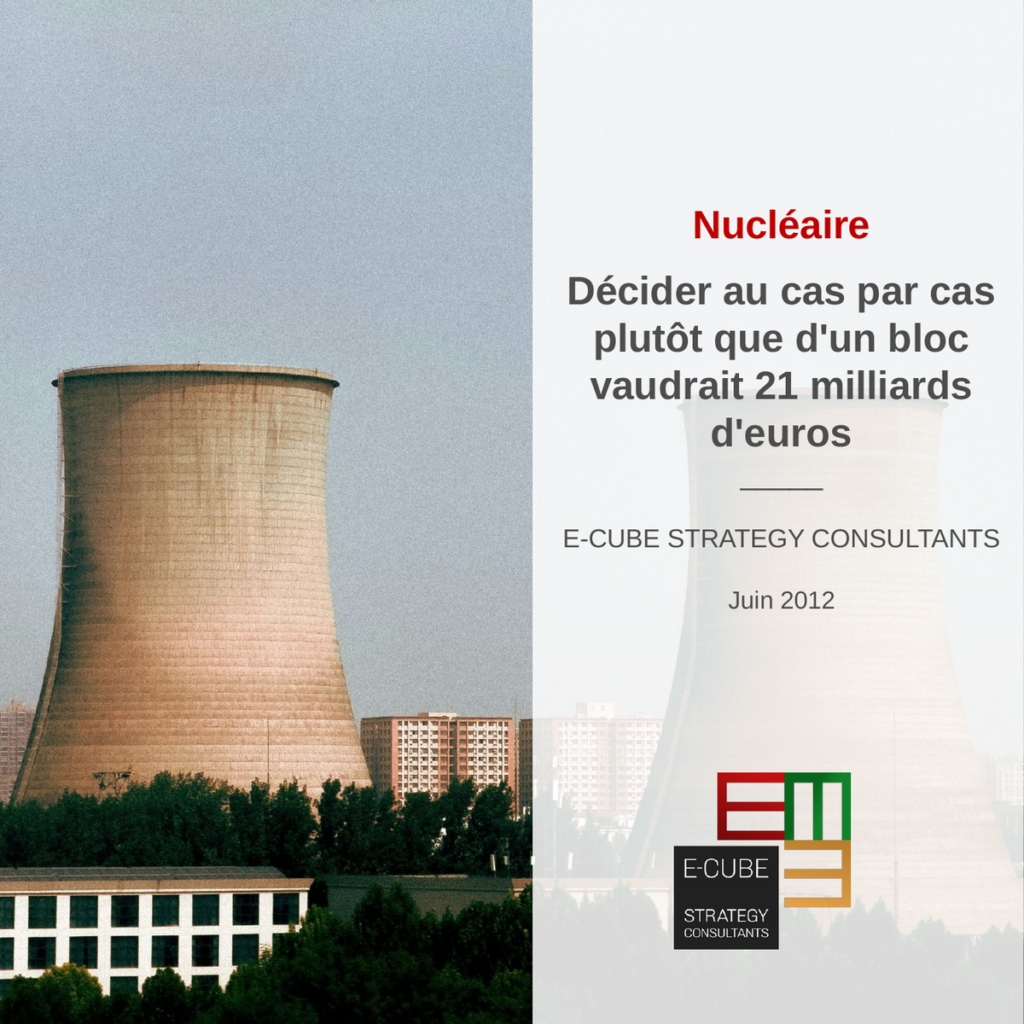
By 2026, France’s 24 oldest nuclear reactors will have reached forty years of operation. Subject to regulatory approval, their operation could continue for another decade. Failing that, the capacity must be replaced by thermal or renewable assets, raising generation costs.
A scheduling constraint shapes the problem. Life extension must be decided at the latest five to seven years before a reactor turns forty, since replacement steam generators have to be ordered long in advance. For the most recent of the reactors concerned, the decision could therefore be taken as late as 2021. By then the political, economic and social environment may have changed profoundly.
Why net present value is not enough
This is the central methodological point. Conventional net present value cannot evaluate a future, conditional investment decision: it does not capture the expected return of an option that has no value today but might tomorrow.
Real options analysis, derived from the financial mathematics of Black and Scholes and adapted to industrial projects by Stewart Myers, does exactly that. We applied it to energy transition scenarios to simulate, between 2012 and 2030, the evolution of the parameters governing replacement of the oldest reactors.
A decisive and unpredictable variable: public acceptance
What distinguishes this analysis from a classic real options study is the inclusion of public opinion. A purely economic approach would, on the assumptions used, systematically conclude in favour of renewing every reactor. It would therefore be of little interest.
The German and Japanese examples show that closure decisions are tied to strong public rejection of nuclear: 72 % of Germans favoured a five-year phase-out in May 2011, 57 % of Japanese opposed restarting plants in March 2012.
Absent any established correlation between acceptance and economic factors, public opinion was modelled as a stochastic process, with an initial level of 45 % and volatility of 11 %. Each closure decision then depends on whether unfavourable opinion exceeds 50 %, five years before the deadline.
An option value of €21 billion
Four scenarios were compared: systematic renewal, systematic closure with replacement by combined cycle plants and renewables, and two dynamic scenarios where the decision is taken case by case.
Under the approach adopted, the average number of reactors closed comes to twelve out of twenty-four. The option value, meaning the gap between the dynamic scenario and a decision not to renew taken now, amounts to €19 to 21 billion of cumulative generation costs between 2012 and 2030, and €25 to 28 billion of gross investment avoided.
Two qualifications matter. The figure is a lower bound, since this option conditions others, notably the possibility of extending operation to sixty or even seventy years as in the United States. And the result is highly sensitive to the threshold chosen: raising the majority to 60 % would increase option value by around €10 billion.
The aim of the study was to illustrate the method rather than to settle the debate. Its results remain theoretical, tied to uncertainty around some structuring assumptions. It nonetheless offers a useful insight: the value of keeping a decision open can be considerable.
To go further, download our full analysis below or contact our experts.
The downloadable PDF of this study is available in French only.