France’s biogas sector is not a matter of energy policy alone. It cuts across biowaste recovery, the environmental footprint of livestock farming, the agronomic value of effluents and the diversification of farm income. That plurality of objectives explains both its political support and its complexity.
Momentum was real: more than 50 plants commissioned in 2014, around 12 MWe. On-farm and territorial sites accounted at end-2014 for roughly 52 % of installed sites but 20 % of capacity, and processed the feedstock that makes up most of the remaining potential, with ADEME estimating that 90 % of the 56 TWh available will come from agriculture.
An almost systematic gap between business plan and reality
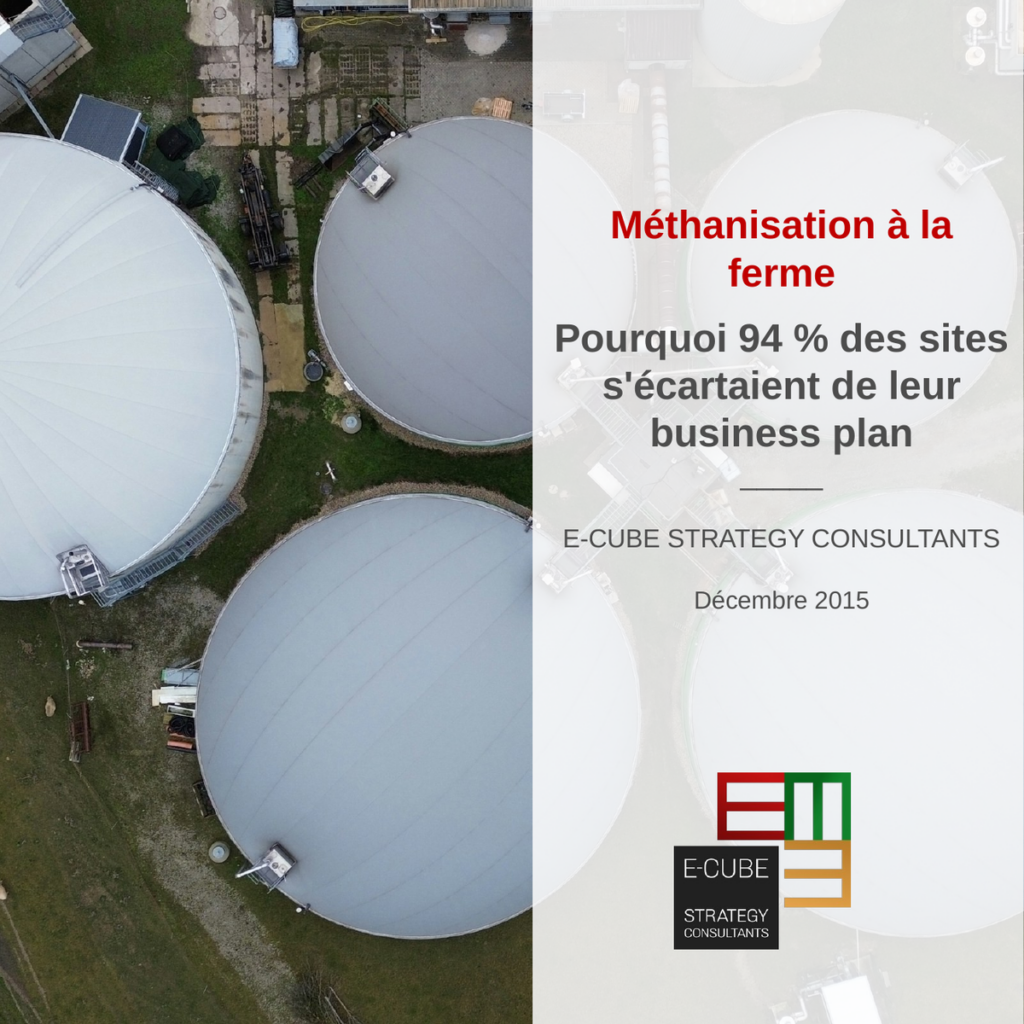
Our sector review, covering 54 sites for ATEE, the farming federations, GRTgaz, GRDF, Engie and Crédit Agricole, produced an unambiguous finding: 94 % of surveyed sites diverged from their forecasts. The gaps affect every size, every vintage and every feedstock type. Recent sites fared no better than older ones.
91 % of sites showed capex overruns, averaging around 5 %, concentrated in storage and the digestion process: feedstock pre-treatment, regulatory compliance upgrades, hygienisation to broaden sourcing. For larger plants, digestate treatment was the second largest overrun.
83 % of sites showed opex overruns, with a heavier profitability impact since breakdowns add lost revenue to repair costs. The panel ran on average 7,200 hours a year. The main items were parts replacement on the digestion process, pumps and agitators, at half the sites, followed by work on the cogeneration engine.
An imported and ill-suited technology reference
The main cause is a design model often copied from the German template, built around a homogeneous, highly methanogenic feedstock, maize, with few contaminants. The French waste-based model produces a heterogeneity that this reference does not anticipate: peripheral equipment missing from capex, wear and breakage missing from maintenance opex.
Structural weaknesses compounded this: uneven competence among engineering consultancies, non-standardised contracts and no after-sales support from some builders, inconsistent competitive tendering by project owners, and preventive maintenance in place at only 20 % of sites. External factors made it worse, notably cross-border competition for the most methanogenic feedstocks and the weakening of German manufacturers, leaving some projects without a counterparty.
A sector caught in a vicious circle
The result is a slowdown in project development, reinforced by tighter bank lending, particularly on territorial projects. The risk is twofold: loss of know-how among developers who had built up expertise, and the persistence of cost under-estimation designed to get projects approved, which simply defers the financial difficulty.
These findings, established on cogeneration, largely apply to biomethane injection: the core process is shared, as are the sourcing and digestate management challenges.
Two optimisation workstreams
- Capex: converge design towards a limited set of schemes suited to French anaerobic digestion, a precondition for standardisation that will only pay off if volumes follow, and make competitive tendering standard practice.
- Opex: improve design to limit premature wear, use competitively tendered preventive maintenance contracts, and reach the fleet size that supports local after-sales service and spare parts stocks.
The precondition remains the same: build support policies on the real costs of the French model rather than on an imported reference.
To go further, download our full analysis below or contact our experts.
The downloadable PDF of this study is available in French only.